Only 37% of IT teams were able to complete all the projects asked of them last year, and are asked
to complete 30% more projects this year
Data silos continue to be a challenge year-over-year for 90% of organizations
Four out of five organizations recognize the need to empower business users to easily integrate apps
and data to deliver connected experiences and drive innovation, faster
SAN FRANCISCO – March 30, 2021
– MuleSoft, provider of the world’s #1 integration and API
platform, today reported that integration challenges continue to be a major roadblock for digital
transformation initiatives. MuleSoft’s 2021
Connectivity Benchmark Report found that IT teams are
spending over a third of their time on integration projects, and custom integrations are costing large
enterprises on average $3.5 million* each in annual labor. As digital initiatives accelerate, integration
has emerged as a critical factor in determining the success and speed of digital transformation across
industries.
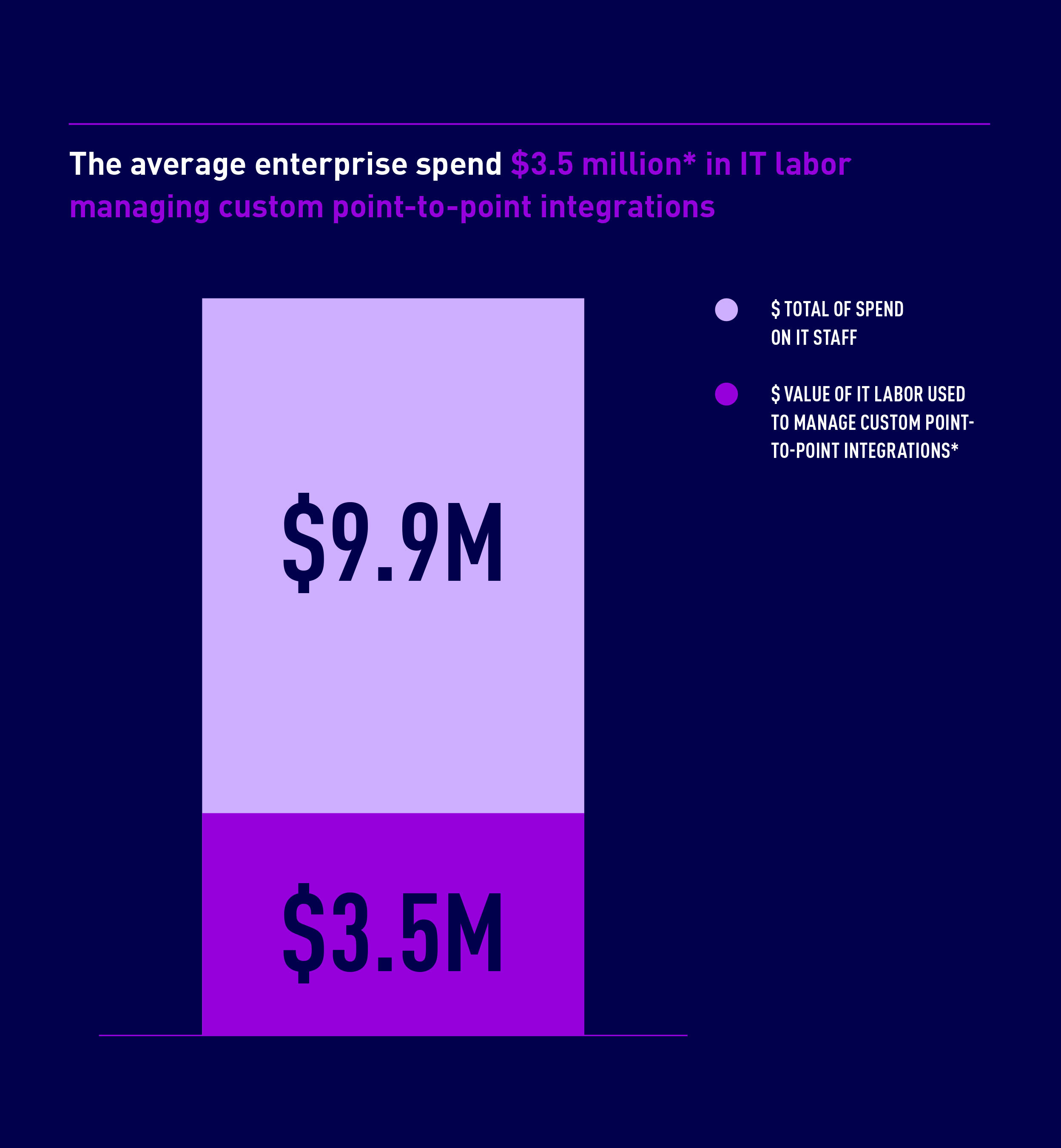
MuleSoft research: Custom integrations cost the average enterprise $3.5 million in annual labor
“Organizations across industries have experienced a rapid shift toward interacting with customers and employees
through digital channels,” said Brent Hayward, CEO, MuleSoft. “Although most organizations are prioritizing digital
initiatives, such as launching an e-commerce platform or increasing worker productivity, the research shows that
data silos continue to hinder their capabilities to deliver on these key initiatives. Companies that empower their
IT and business teams to easily integrate apps and data will be able to unlock the full capacity within their
organization to drive innovation at scale and gain competitive edge.”
Based on a global survey of 800 CIOs and IT decision makers, the 2021 Connectivity Benchmark Report also highlights
new challenges and opportunities for businesses as they navigate a digital-first world:
Increased demands pressuring businesses to deliver digital faster
The last 12 months have seen a profound shift in the way people work and how organizations operate. Employees and
customers alike want seamless digital experiences and expect organizations to deliver on these experiences, faster.
● New initiatives to enable success from anywhere: This past year, organizations relied on IT to
support a rapid shift to remote working and the need for increased productivity and efficiency. Migrating apps to
the cloud (51%), enabling remote working (48%) and automating business processes (47%) were cited as the key
initiatives that organizations are focusing on for 2021. They were closely followed by using IT to create a safe
working environment, modernizing legacy systems, and integrating SaaS apps (each 45%).
● When demand surpasses supply: Demands on IT have increased massively. Organizations asked IT to
deliver on average 30% more projects this year, a number that is constantly growing year-over-year (315 projects in
2021 compared to 242 projects in 2020). Only 37% of respondents say they were able to deliver all IT projects last
year (compared to 41% the previous year).
● Go digital or get left behind: More than three-quarters (77%) of organizations say a failure to
complete digital transformation initiatives will impact revenues over the next year.
● The cost of “keeping the lights on”: IT is spending over two-thirds of their time (68%) on
running the business, leaving little time for innovation and development of new projects.
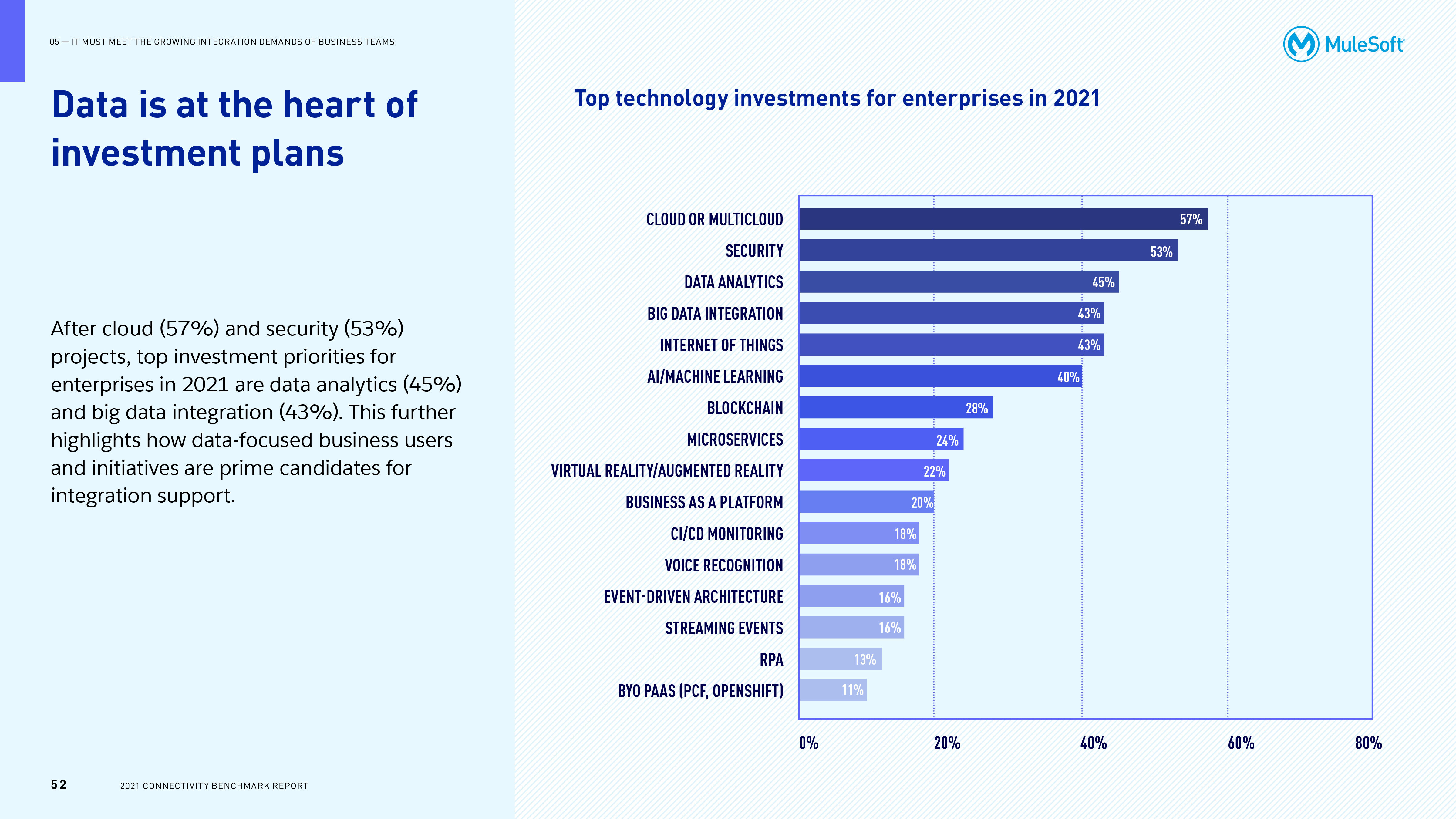
MuleSoft research: The demand on IT continues to grow
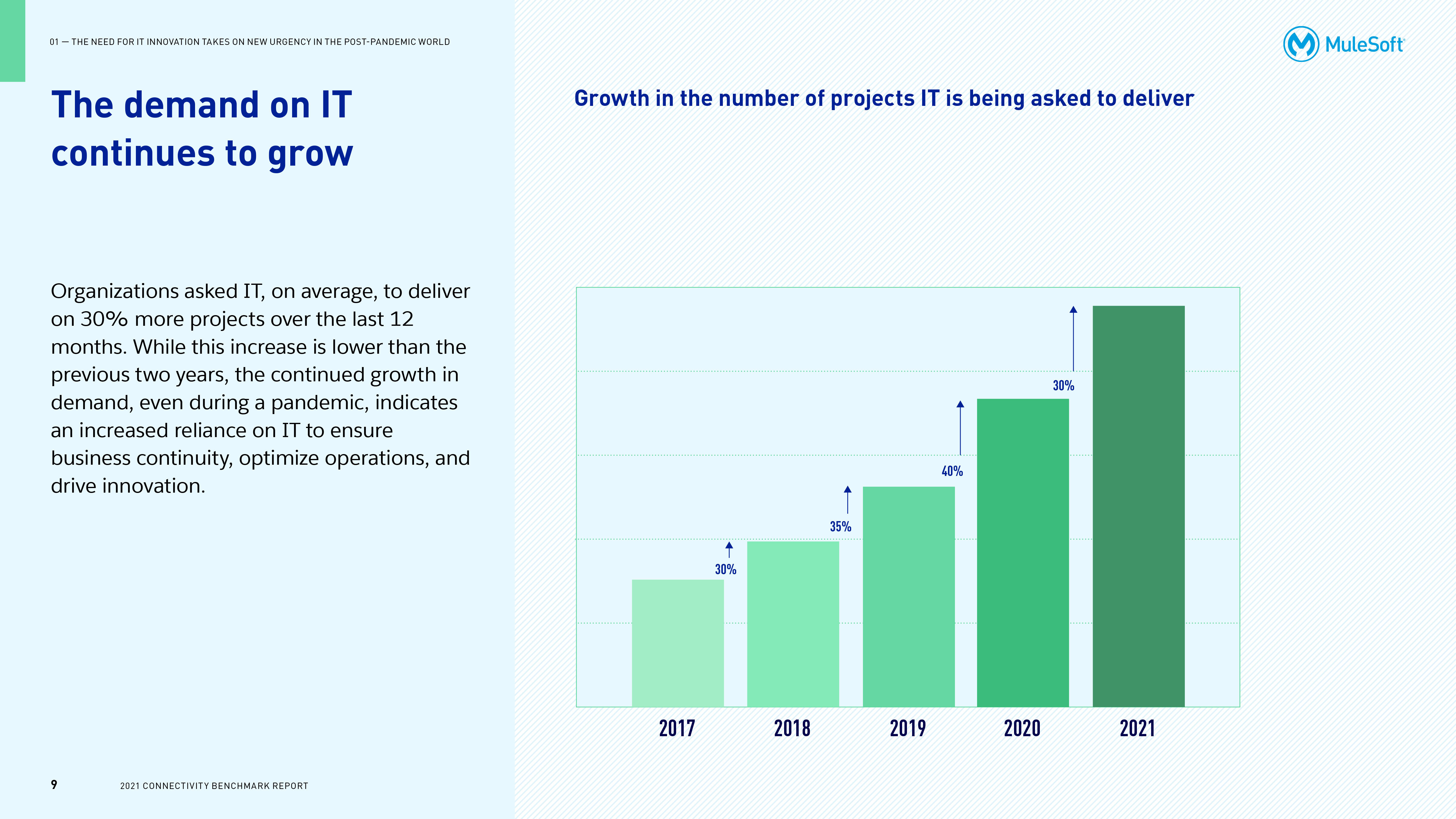
MuleSoft research: Top technology investments for enterprises in 2021
Integration challenges hold businesses back
Data silos remain a challenge for 90% of organizations (unchanged since last year’s report). And almost 9 in 10
respondents point to integration challenges as a blocker to delivering on digital transformation. If this trend
continues, it risks stalling key business initiatives for many organizations. Integration will continue to be a
major area of focus as organizations look to connect and derive more value from their new and existing apps and
data.
● So many applications, so little integration: On average, organizations use 843 individual
applications. However, only 29% of these applications are integrated (a slight increase from 28% in the previous
year), highlighting huge potential for organizations to drive change and deliver more connected experiences.
● Connected customer experiences remain a challenge to achieve: Only 18% of organizations integrate
end-user experiences across all channels, with almost half (48%) stating they have found it difficult to do so.
However, for those organizations that have successfully integrated end-user experiences, increased customer
engagement (53%), business transformation (53%) and innovation (50%) have been the major benefits.
● Data-related roles have the biggest integration needs: Outside of IT, data science (47%),
business analyst (42%) and finance (42%) are the roles with the biggest integration needs. This further highlights
how business users and initiatives with a data focus are prime candidates for integration support.
Empowering enterprise-wide innovation
Organizations recognize the strategic importance of integration to help achieve revenue goals and deliver connected
experiences faster. To lessen the integration burden on IT and drive innovation and productivity, organizations are
looking to drive reuse of existing integrations and empower the wider business to connect apps and data.
● Integration and API strategy is being led from the top: More than two-thirds (69%) of
organizations say they have a top-down approach to integration and API strategy. This is an increase from 63% last
year, highlighting the growing importance of integration to achieving business goals.
● API reuse is a massive area of opportunity: While most organizations (96%, up from 80% last year)
are using APIs to build integrations and deliver new projects, best practices around API reuse remain an area of
improvement. The reuse of code, APIs, and best practice templates has plateaued over the last two years.
Organizations have on average 42% of such internal assets and components available for reuse. This is a massive area
of opportunity as organizations leveraging APIs experience increased productivity (59%), self-service (48%) and
increased innovation (46%).
● Enabling all business users: Four in five organizations recognize the need to make data and
integration accessible to business users to increase productivity, deliver connected experiences and drive
innovation. Over a third (36%) of organizations say they have a mature approach to enabling non-IT users to easily
integrate apps and data sources through APIs. Another 44% say they are in the process of developing plans, further
highlighting that organizations are looking to empower business users with integration.
Additional information:
● For deeper insight into how organizations around the world are driving their digital transformation initiatives,
download the 2021 Connectivity Benchmark
Report.
● Register to virtually attend MuleSoft CONNECT, the world’s leading
integration event, to learn best practices for solving the business challenges and trends that are shaping the
future of IT.
Methodology
For the sixth-annual Connectivity Benchmark Report, MuleSoft, in partnership with Vanson Bourne, surveyed 800 IT
leaders from global enterprises. The goal was to uncover how much value businesses actually gain from digital
transformation, and to understand IT leaders’ most successful strategies for achieving digital transformation goals.
The online survey was conducted between December 2020 and January 2021 across the United States, the United Kingdom,
France, Germany, Netherlands, Australia, Singapore, Hong Kong and Japan. Only suitable candidates participated in
the survey and were verified by using a rigorous, multi-level screening process. All respondents work at an
enterprise organization in the public or private sector with at least 1,000 employees and hold a managerial position
or above in an IT department.
*Survey respondents stated on average they spent $9,870,901 on IT staff (both on employee salaries and external
contractors) over the last 12 months.
Cumulatively survey respondents stated on average their IT teams were spending 35.55% of their time designing,
building, and testing custom integrations.
$9,870,901 x 35.55% = $3,509,105.31
About MuleSoft, a Salesforce company
MuleSoft, provider of the world’s #1 trusted integration and API platform,
empowers any company to quickly unlock and integrate their apps and data
to create connected experiences, faster. For more information, visit: https://www.mulesoft.com.
About Salesforce
Salesforce, the global CRM leader, empowers companies of every size and
industry to digitally transform and create a 360° view of their customers.
For more information about Salesforce (NYSE: CRM), visit: www.salesforce.com.
MuleSoft is a registered trademark of MuleSoft, Inc., a Salesforce
company. All other marks are those of respective owners.